
The Implementation Project (TIP) attended the 19th Session of the United Nations Expert Mechanism on the Rights of Indigenous Peoples (EMRIP) from July 13 to 17, 2026, at the Palais des Nations in Geneva, to support Tribal Nations in calling attention to Indigenous Peoples’ issues arising in the United States and abroad.
During the 19th session, Human Rights Council President Sidharto Reza Suryodipuro of Indonesia and High Commissioner for Human Rights Volker Turk of Austria, provided opening remarks recognizing the human rights concerns of Indigenous Peoples globally. EMRIP announced the new EMRIP Chair, Dr. Valmaine Toki, and Vice Chairs Dalee Sambo Dorough and Annexa Alfred Cunningham, and a programme of work focused on EMRIP’s draft thematic study on the rights of Indigenous Peoples in conflict and post-conflict situations, as well as Indigenous Peoples’ enhanced participation at the UN, the International Decade of Indigenous Languages, and Twenty Years of the UN Declaration on the Rights of Indigenous Peoples.
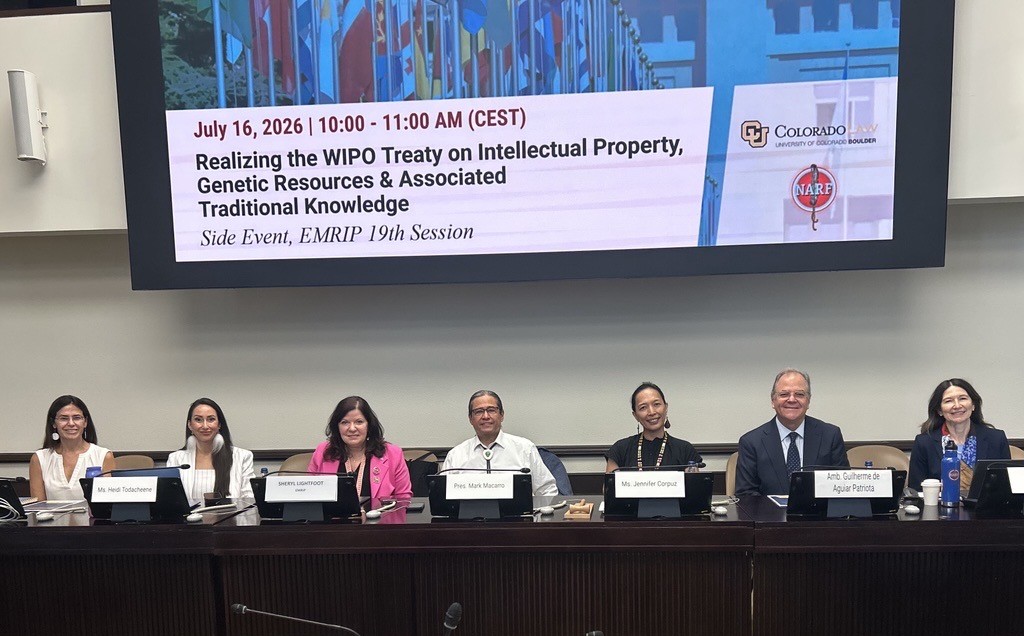
One primary area of focus for TIP’s work during the session was the World Intellectual Property Organization (WIPO) Treaty on Intellectual Property, Genetic Resources and Associated Traditional Knowledge (GRATK Treaty), adopted by WIPO Member States in 2024 after nearly 25 years of advocacy by Indigenous Peoples. TIP hosted a high-level side event entitled, “Realizing the WIPO Treaty on Intellectual Property, Genetic Resources & Associated Traditional Knowledge,” with co-sponsors the Native American Rights Fund (NARF), University of Colorado Law School, and the National Congress of American Indians (NCAI). TIP was honored to include the featured panel speaker Ambassador Guilherme de Aguiar Patriota, Permanent Mission of Brazil to the World Trade Organization and other economic organizations in Geneva, who served as President of the Diplomatic Conference that led to the Treaty’s adoption. Other distinguished panel speakers included NCAI President Mark Macarro; UN Permanent Forum Member and Co-Chair of the Indigenous Caucus during the Diplomatic Conference Jennifer Tauli-Corpuz; EMRIP Member Sheryl Lightfoot; and Principal of IndigiNational Strategies Heidi Todacheene. These prominent voices highlighted the GRATK Treaty as a successful example of multilateralism with the potential of protecting Indigenous Peoples’ traditional knowledge, curbing biopiracy, and fostering transparency in patent law. Panelists urged all countries to join the GRATK Treaty, following the 44 countries that have signed the treaty, four countries that have ratified, and others, including Australia and Switzerland, who have started the process.
EMRIP Mandates: Country Engagements
In the main session, EMRIP reported on its work during the recent year. Pursuant to UN Human Rights Council resolution 33/25, the Expert Mechanism undertook its sixth country engagement and followed up on another, as a critical part of its mandate for constructive problem-solving on specific issues faced by Indigenous Peoples.
Brazil: Country Engagement
From June 1 to 10, 2026, EMRIP embarked on a country engagement mission to Brazil to provide expert advice on the rights of Indigenous Peoples living in voluntary isolation. The visit took place in response to a request from the International Working Group of Indigenous Peoples in Isolation and Initial Contact, an alliance of 21 Indigenous organizations from South America dedicated to protecting and promoting Indigenous Peoples’ rights. The report containing EMRIP’s advice based on the country engagement is forthcoming.
Canada: Technical Assistance
EMRIP also provided technical advice to Canada in May 2026, regarding amendments to its domestic legislation, the Indian Act, originally passed into law in 1876. This was as a follow-up for technical assistance under the mandate rather than a new country mission. The Expert Mechanism’s technical advice on the Indian Act is tied to Canada’s national legislation, adopted in 2021, requiring Canada’s federal laws be brought into consistency with the UN Declaration on the Rights of Indigenous Peoples, that the government develop a national action plan, and that it submit annual reports on implementation to Parliament.
Interventions: Agenda Items No. 7, 10 & 12
International Decade of Indigenous Languages (Agenda Item No. 7) & Preparing for Twenty Years of the Declaration (Agenda Item No. 10)
The American Indian Law Program (AILP) at the University of Colorado Law School made interventions during EMRIP on the International Decade of Indigenous Languages (Agenda Item No. 7) and Preparing for Twenty Years of the United Nations Declaration on the Rights of Indigenous Peoples (Agenda Item No. 10).
First, AILP emphasized prior U.S. administrations’ Indigenous-led federal language revitalization initiatives and urged EMRIP to welcome innovations moving forward. It highlighted two examples including the Cherokee Nation’s assumption of oversight for its immersion school and the Agua Caliente Band of Cahuilla Indians’ collaboration with California to implement Indigenous public-school curricula, and ended by requesting that all Member States support Indigenous-led innovations through greater political and financial backing.
Secondly, in preparation for the Declaration’s twenty-year anniversary, AILP highlighted past U.S. commitments on domestic implementation of the Declaration, while emphasizing Indigenous Peoples’ and organizations’ calls for stronger action. This includes calls that the U.S.: 1) appoint the first U.S. Indigenous Ambassador or Special Envoy for Indigenous Issues at the Department of State; 2) develop a National Action Plan for implementation of the Declaration; 3) support enhanced UN participation for Indigenous Peoples; and 4) ratify the WIPO GRATK Treaty. AILP requested that EMRIP recognize these achievements, while urging all States, including the U.S., to fully implement the Declaration. A recording of AILP’s statement can be viewed here, at timestamp 1:48:00.
Proposals to be Submitted by EMRIP to the Human Rights Council (Agenda Item No. 12)
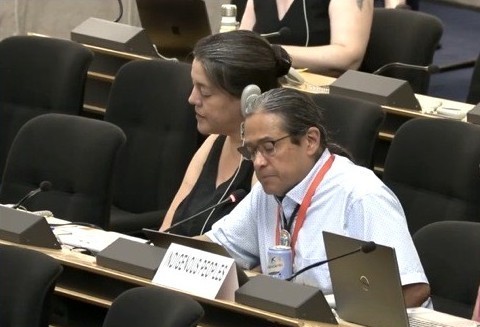
Agenda Item No. 12 concerned proposals to be submitted by EMRIP to the Human Rights Council (HRC) for its consideration and approval. NCAI President Mark Macarro delivered an intervention under this agenda item on behalf of NCAI and NARF. The intervention highlighted Article 31 of the Declaration, which affirms Indigenous Peoples’ “right to maintain, control, protect and develop” their genetic resources and traditional knowledge, and articulates States’ obligations to “take effective measures to recognize and protect the exercise of these rights.” The intervention requested EMRIP to continue elevating the call for action on the GRATK Treaty by recommending that the HRC urge States to become parties to the Treaty and to fully implement it, in conjunction with Indigenous Peoples, in accordance with Article 31. A recording of the NCAI and NARF statement can be viewed here, at timestamp 00:11:40.
Panel discussion on Indigenous Peoples and Artificial Intelligence (Agenda Item No. 8)
Agenda Item No. 8 focused on the rights of Indigenous Peoples and Artificial Intelligence (AI). Member States and Indigenous Peoples in attendance discussed AI’s potential to support Indigenous languages, knowledge, and cultural preservation, but also raised immediate concerns about the exclusion of Indigenous Peoples from AI development, lack of free, prior, and informed consent (FPIC), and the impacts of data centers on Indigenous lands, waters, climate, and digital equity. A recording of the Artificial Intelligence panel can be viewed here.
Next Steps
EMRIP will finalize and deliver its thematic study on the Rights of Indigenous Peoples in conflict and post-conflict situations, as well as its report of the 19th session, to the HRC during its sixty-third session taking place in Geneva, September 7 to October 9, 2026.
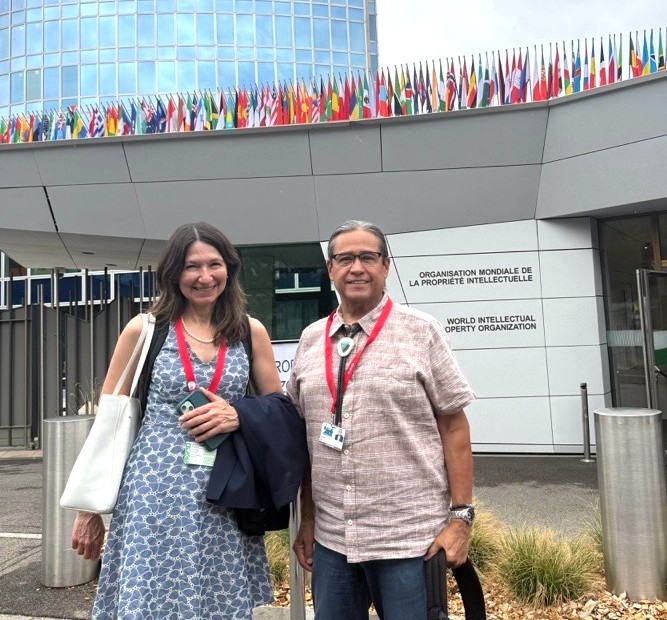
Special thanks to Heidi Todacheene, Principal of IndigiNational Strategies, for authoring this article.